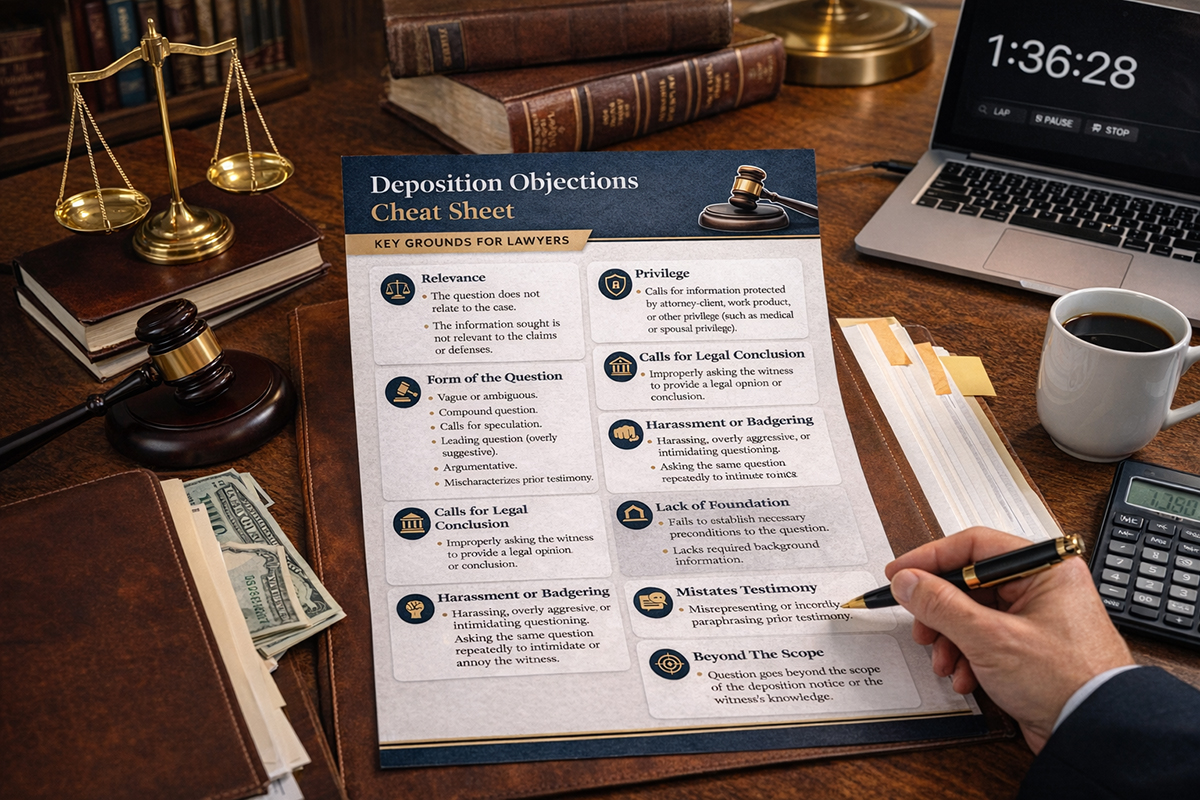
Key Takeaways
- Deposition objections protect the witness and preserve issues for trial. Major objections include form of the question, asked and answered, relevance, privilege, speculation, legal conclusion, harassment, and mischaracterization of testimony.
- Form objections cover problematic question structure (e.g. compound, vague, leading). Note: Failing to object to form during a deposition typically waives that objection later.
- Asked and answered objections stop repeated questioning on the same point.
- Relevance objections keep questioning focused. You can object if a question is clearly off-topic or unrelated to the case issues.
- Privilege objections are the one exception that lets a witness refuse to answer. Invoke attorney-client, spousal, Fifth Amendment or other privileges whenever privileged information is sought.
- Non-allowed objections: In depositions, you generally cannot object to hearsay or opinions (expert or lay), since discovery rules allow those inquiry forms. Focus on permitted objections to stay strategic.
This post provides a clear deposition objections cheat sheet for litigators. It explains why and when to raise objections during depositions and lists the most common objections with examples. Key objections include form-based issues (compound, leading, etc.), relevance, privilege, speculation, legal conclusions, harassment, and mischaracterization. It also notes that if you fail to object to the form of a question at deposition, you generally waive that right later. The goal is to preserve fair testimony without unduly interrupting the process. (Modern tools like Time Miner’s legal timekeeping software can even capture the attorney’s deposition prep time automatically, so all billable work is recorded while you focus on objections.)
Introduction
A deposition is sworn testimony taken outside of court, often during the discovery phase of litigation. During a deposition, lawyers may object to certain questions to protect the witness and preserve grounds for trial. Unlike in-court objections, most deposition objections do not stop the witness from answering (except for privilege) – the purpose is to flag improper questions for the record. This cheat sheet covers the most common objections you might raise at a deposition, with examples and tips from legal experts. By preparing these objections in advance, you can efficiently maintain control of the deposition, protect your client’s rights, and ensure key issues are preserved.
Why object? Raising objections in a deposition helps keep questioning fair and focused. It shields the witness from confusing, leading, or harassing questions, and preserves legitimate objections (like form issues) for trial. Even though the witness usually must answer, the fact that you objected will support motions later if the testimony needs to be excluded.
Common Deposition Objections
Form of the Question
Objecting to the form of a question means the lawyer finds something improper in how the question is phrased, not necessarily that the topic is improper. Typical form issues include compound questions (multiple queries in one), leading questions, and vague or ambiguous questions. For example, “Did you talk to your manager, and did he tell you to ignore the complaint?” is compound. You would say “Objection, form.” to ask opposing counsel to break it into one question at a time. Similarly, if a question is unclear or overly broad, you can object to form. Importantly, depositions follow special rules: if you fail to object to the form at the deposition, you generally lose the right to make that objection later. In short, watch out for unclear or multi-part questions and object promptly to keep the record straight.
Asked and Answered
If the witness already answered a question fully, the same or a rephrased question is improper. An asked and answered objection stops repetitive questioning designed to badger the witness. Example: the examiner asks “You weren’t at the meeting?” and the witness says “No.” A few questions later, the examiner asks “You didn’t attend the meeting on the 12th?” – this is essentially the same inquiry. You should say “Objection, asked and answered”. This objection lets you move on and protect the witness from undue harassment, while keeping the prior answer on record.
Relevance (Scope)
A relevance objection is used when a question appears unrelated to the claims or defenses in the case. In depositions, discovery is broad, but opposing counsel still cannot stray too far off-topic. For example, asking “What medications are you currently taking?” in a simple contract dispute would likely be irrelevant and invasive. You can object by saying, “Objection, relevance — that line of questioning isn’t relevant to this case”. Relevance objections signal that counsel needs to stick to pertinent issues. (Note: Some jurisdictions restrict relevance objections at deposition unless it’s clearly a fishing expedition; check your local rules.)
Privilege
Privilege objections are the main exception where you can instruct the witness not to answer. If a question asks for privileged communication (e.g. between client and attorney, doctor and patient, or a spouse on a confidential matter), you should object on privilege grounds. For instance: “Did you and your lawyer talk about possible settlement?” – reply, “Objection, counsel. That question seeks privileged information”. Raising privilege protects the client’s confidential information and preserves that objection for trial. Remember, privilege objections must be timely; if you let privileged questions be answered, you generally waive the privilege.
Calls for Speculation
If a question asks the witness to guess, infer, or speculate beyond their personal knowledge, object on the grounds that it calls for speculation. Deposition testimony must be based on the witness’s own knowledge and memory, not conjecture. For example: “Why do you think your supervisor didn’t promote you?” – the witness likely doesn’t know. Object by saying “Objection, calls for speculation”. This keeps the focus on facts. (By contrast, some deposition objections like hearsay or opinion are typically not made, since discovery can include those; see FAQs below.)
Calls for a Legal Conclusion
Deposition witnesses are generally not expected to make legal judgments. If a question asks the witness to interpret the law or draw a legal inference, object as a legal conclusion call. For instance: “Do you agree that your employer owed you a duty of care?” is a legal question. An appropriate objection is “Objection, counsel, calls for a legal conclusion”. This keeps the testimony factual. (A qualified witness, like an expert witness, might give opinions, but lay witnesses should stick to facts.)
Harassment or Badgering
If opposing counsel’s tone or method is abusive – harassing, argumentative, or designed to intimidate – you should object to harassment. For example, asking a witness personal questions unrelated to the case or insulting them can be badgering. You might say “Objection, harassment — that question is not relevant and is harassing the witness”. Courts allow depositions to explore facts, but not at the expense of a dignified process. You can also request a break or even terminate the deposition in extreme cases. The aim is to maintain a respectful environment.
Mischaracterization of Testimony (Improper Characterization)
Sometimes opposing counsel may misquote or distort prior testimony to confuse the witness. If a question mischaracterizes what the witness said, object on mischaracterization (or improper characterization) grounds. For example: “Earlier you said your supervisor threatened you, correct?” – if the witness never said that (maybe they said they felt intimidated), respond “Objection, counsel. That mischaracterizes my prior testimony”. This objection keeps the record accurate and protects the witness from being trapped by subtle rephrasing.
Cumulative or Unduly Repetitive (when needed)
If a line of questioning becomes needlessly repetitive or cumulative, you can object on those grounds. Though not always listed among “big” objections, high-quality objections guides note that repetitive or cumulative questioning can be objected to avoid wasting time. For example, if counsel has already exhausted a topic, you may say “Objection, cumulative” to indicate you’ve already covered this line of inquiry. Use this sparingly – it’s more common in trial, but depositions allow it if it truly burdens the witness.
Timing and Strategy
- Prepare in advance: Familiarize yourself with likely topics. Plan objections ahead and keep notes accessible. As one source advises, collaboration and clear communication with the witness before the deposition will “ensure that you remember key facts… and are ready to state objections as they arise”.
- Speak sparingly and professionally: You are generally just stating “Objection, [ground],” and perhaps a brief explanation if needed. Long speeches can be viewed as coaching. Clarity is key: very briefly state the objection, then let the witness answer if required.
- Document everything: After the deposition, review your objections and ensure the reasoning is clear for future motions. Because objections must be on the record to preserve error, make each objection count and consider taking quick notes of important responses.
- Follow local rules: Deposition objection practices can vary by jurisdiction. For example, some places allow relevance objections only if truly harassing. Always check the rules for depositions in your court or state to use each objection appropriately.
Conclusion
Mastering deposition objections is essential for protecting your client and preserving case issues. By using this cheat sheet’s guidance on form, relevance, privilege, and other key objections, you can confidently steer depositions while keeping full control of the testimony. Remember that objections are part of the legal record, so state them clearly and concisely. Staying organized – even using digital tools – helps you object effectively and preserve your client’s rights.
At the same time, do not lose sight of practical matters: make sure to record the time spent on depositions and prep. For example, TimeMiner’s solution automatically captures all client-related communication (email, calls, etc.) so your deposition work is fully accounted for. In short, thorough preparation of objections combined with accurate timekeeping ensures no opportunity is missed – both legally and financially.
Frequently Asked Questions
Q: If a witness is asked a question I find improper, do I object every time?
A: No. Objections should be strategic. Only object when it’s a significant issue (e.g. compound questions, privilege, harassment). Over-objecting can frustrate the process. Focus on the major categories listed above. Remember, most objections at a deposition are not to block testimony but to preserve error, so object mainly to crucial points.
Q: Can I tell the witness not to answer every time I object?
A: Generally, no. Except for privilege issues, the witness usually must answer despite an objection. The purpose is to put the objection on record. Only in rare cases (like privilege or court order) do you refuse to let them answer. Otherwise, you object while they answer, so you have the record to challenge it later if needed.
Q: Is hearsay objection allowed at deposition?
A: No, as a general rule you cannot object on hearsay alone during a deposition. Depositions allow discovery, and witnesses may repeat hearsay. The deposition transcript could lead you to the hearsay source for live testimony later. So focus on objections that are permitted (form, privilege, etc.).
Q: What about opinions or expert testimony? Can I object for lack of foundation?
A: Foundation objections (e.g. assumption of fact not in evidence) are largely waived in depositions, because non-experts can give opinion on factual matters during a deposition. You usually cannot demand that a witness be qualified as an expert during a deposition (that’s done at trial). If a lay witness strays too far into pure opinion, you might object for speculation or lack of personal knowledge, but expert opinions are tested differently.
Q: What happens if I don’t object to the form at the deposition?
A: Failing to object to a question’s form (clarity, compound nature, etc.) during the deposition typically means you waive that objection later. This is why form objections are crucial in depositions. Always catch compound or confusing questions on the spot, or else you lose the chance to challenge them at trial.
Q: Can I assert attorney-client privilege at a deposition?
A: Yes. If a question calls for privileged information, object on that basis and instruct the witness not to answer. Common privileges include attorney-client, doctor-patient, spousal, and the Fifth Amendment. For example, if asked about communications with their lawyer, you would object: “This question calls for privileged information”.
Q: How can I ensure I capture time spent on depositions?
A: While not strictly a deposition objection, it’s worth noting that preparing and taking depositions is billable work. Modern tools (like Time Miner’s automated timekeeping platform) can track all time spent on depositions and prep by scanning emails, calls, and calendars. This way, no billable minute is lost while you focus on objections and questioning.