
Key Takeaways
- Flat-fee billing is gaining popularity, with firms handling significantly more fixed-fee work and often generating higher average revenue per matter.
- A large majority of clients prefer flat fees due to cost predictability and transparency.
- Flat fees work best for well-defined, repeatable legal services such as contracts, wills, and uncontested matters.
- This pricing model improves client trust, cash flow, and operational efficiency for law firms.
- The biggest risk is underestimating effort, which can reduce profitability if not managed properly.
- Clear scope definition, market research, and continuous pricing review are essential for success.
- Time tracking remains critical even in flat-fee models to measure effort, optimize processes, and refine pricing.
- Technology like automated time tracking tools helps capture all billable activity and prevents revenue leakage.
- A hybrid billing approach (flat-fee + hourly) is often the most practical strategy for modern law firms.
In recent years, many law firms have begun to move away from strictly hourly billing and toward flat-fee pricing for certain services. Industry reports indicate that flat fees are on the rise: firms are logging about 34% more work on a flat-fee basis compared to 2016, and flat-fee matters now bring in roughly 20% higher revenue on average. At the same time, clients are increasingly drawn to fixed pricing. For example, a survey found that 71% of clients prefer to pay a flat fee for their entire case.
What Is Flat-Fee Billing?
Flat-fee billing (also called fixed-fee billing) means charging one set price for a defined legal service or project, rather than billing by the hour. For example, a firm might charge a single flat fee of $500 to handle a contract review (covering the initial consultation, drafting, and filing) instead of tracking each hour at $300. This approach is often viewed as value-based billing: the fee reflects the overall scope and value of the work, not just the time spent.
Flat fees tend to work best for predictable, well-defined matters. Simple transactional tasks are common candidates: uncontested divorces, traffic-ticket defense, basic wills, contract drafting, real estate closings, and other routine matters. In contrast, highly complex or unpredictable cases (major litigation, complicated personal injury, etc.) are usually kept on hourly billing, since it is difficult to estimate those in advance.
Benefits and Drawbacks of Flat Fees
Flat-fee billing offers clear advantages. Cost certainty is a primary benefit: clients know up front exactly what they will pay, which builds trust and avoids surprise bills. With a fixed price agreed in advance, there are no invoice shocks later, which strengthens the attorney-client relationship from the outset. It also means firms often receive one lump-sum payment rather than piecemeal bills, which can improve cash flow.
Flat fees also encourage efficiency. When a lawyer’s payment is fixed, there’s an incentive to streamline processes and work smarter. For example, a more efficient method for drafting a routine document, completed in less time, still earns the same fee. Over time this can raise productivity and reduce costs. Finally, offering transparent flat fees can differentiate a firm in a competitive market by providing clear, easy-to-understand pricing from the very start.
However, flat fees have challenges too. Predicting exactly how much work a matter will take can be difficult. If the firm underestimates the time or resources required, it may end up doing significantly more work than planned for the same fee, which erodes profitability. Lawyers may also feel pressure to cut corners or rush tasks to protect their margins. In practice, this means firms must carefully analyze costs and include safeguards (such as clearly defined scope clauses and provisions for additional work). These measures help prevent unprofitable scenarios.
Setting Up Flat-Fee Billing
Implementing flat fees successfully requires careful planning and review:
Figure: A detailed flat-fee engagement letter clearly defines included services and fees, avoiding misunderstandings.
Analyze your costs and processes. Before assigning any flat fees, examine how your firm operates. Review past matters to see how many hours similar cases took, and include all relevant expenses (attorney time, support staff, overhead, etc.) when pricing a service. One firm described how it “picked up the phone” to consult colleagues and thoroughly weigh whether the benefits of flat fees would outweigh the costs. Use this data-driven analysis to build a realistic baseline for pricing each service.
Define the scope clearly. Spell out exactly what work is covered by each flat fee—and what is not. List every task or deliverable included (for example: consultations, drafting documents, filing papers, etc.) so both the lawyer and client understand the engagement. Transparency in the engagement letter prevents disputes. If additional work arises beyond the original scope, clarify up front whether that will require an adjusted fee or an hourly add-on.
Research market rates. Investigate what other lawyers charge for similar services in your area or practice niche. Understanding the local market helps you set a competitive yet profitable flat fee. You don’t have to match other firms exactly, but knowing the range of fees in your practice area ensures you neither underprice nor leave money on the table.
Pilot and refine. Start by offering flat fees for only a few well-chosen services. Track those cases closely: after each flat-fee matter, compare the hours actually spent to the fee collected. Use the results to adjust your pricing: if a service consistently costs more time, raise the fee (or adjust the scope); if it costs less, consider lowering the fee or offering it more broadly. This iterative approach helps ensure your flat fees stay aligned with actual costs.
Best Practices for Flat-Fee Engagements
Maintaining flat-fee success also depends on good practices:
Communicate openly with clients. Explain the flat-fee arrangement clearly up front. Make sure clients know exactly what the fee covers, what it does not, and when payment is expected. If additional work will require a new agreement, state that up front. Transparent communication builds client trust and keeps expectations aligned.
Use project management and time tracking. Even under flat fees, maintain discipline in tracking tasks and time. Use case-management software or simple tools (calendars, to-do lists) to monitor deadlines and assignments. Keep internal records of how much time is spent on each task (even if you won’t bill it) so you have data to analyze efficiency. This ensures nothing is missed and provides insights for future pricing decisions.
Regularly review and adjust pricing. The legal marketplace and your firm’s costs can change. Periodically revisit your flat fees: compare them to your actual costs and to what other firms charge. Update the fees upward if needed, or adjust them downward if market factors allow. Regular review prevents fees from becoming outdated or unprofitable.
Foster continuous improvement. A flat-fee model rewards efficiency, so make optimization an ongoing goal. Encourage team members to suggest workflow improvements, and use time-tracking data to identify bottlenecks. For example, if drafting a certain document repeatedly is time-consuming, build a template to save effort. Routinely refining your processes will boost productivity and client satisfaction.
The Role of Time Tracking
One theme runs through every best practice above: time tracking remains critical, even under flat fees. Accurate time data lets a firm judge whether its fixed pricing is truly working. By diligently logging hours (or using automated tools that capture them), firms gain insights into actual work effort and profitability.
Identify inefficiencies. Time records show which tasks or workflows consume more time than expected. Analyzing this data helps pinpoint bottlenecks and optimize processes.
Justify and adjust fees. If tracking reveals a flat-fee matter consistently requires extra hours, the firm has clear evidence to raise that flat fee. Conversely, if cases routinely take less time, the firm can consider lowering those fees or offering discounts.
Spot profitable vs. costly work. Tracking distinguishes which flat-fee services yield healthy margins and which do not. If certain case types consistently lose money, the firm can reconsider offering them or adjust pricing accordingly.
Demonstrate value to clients. Detailed time logs (even if not billed to the client) can be shared to show clients exactly how their case work was performed. This transparency builds trust and helps clients see that they are receiving value for the flat fee.
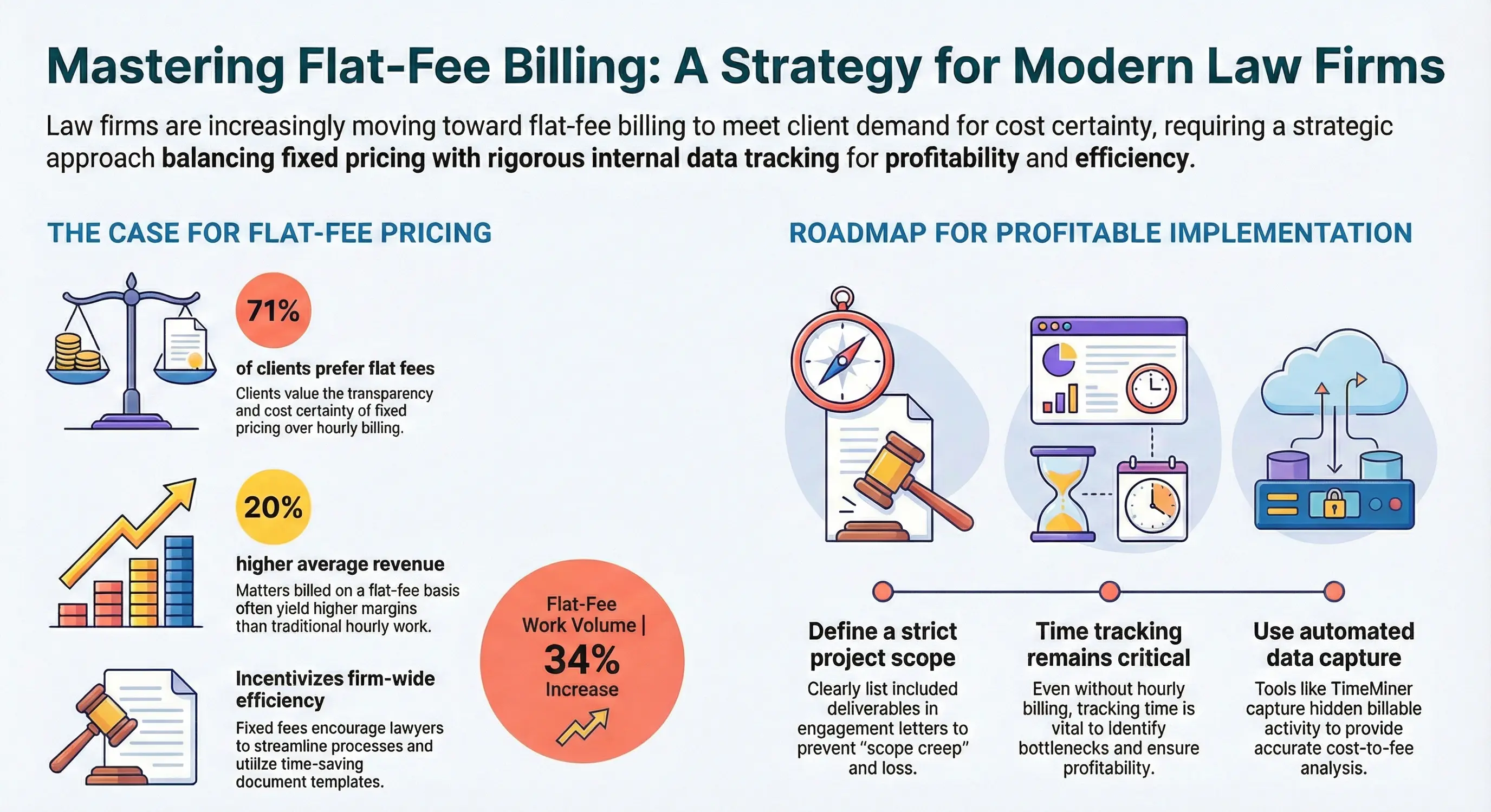
Modern law practices use technology to automate this tracking. For instance, Time Miner is a system that automatically captures all billable activity (emails, calls, texts) and links it to the right client matters. No timers or manual entry are needed – Time Miner simply “mines” past communications for any billable time. By capturing every billable minute, such tools ensure no work is lost, which is especially important when fees are flat. Over time, this gives the firm the complete picture of effort behind each flat-fee matter.
Automated time capture also speeds up billing. It simply integrates with email and phone platforms as well as case-management software, so lawyers can easily export their captured time into invoices or reports. This efficiency helps firms send bills promptly. In fact, firms using flat fees tend to issue invoices much faster and collect payments sooner than firms relying solely on hourly billing.
See Time Miner in action. Start your 30-day free trial now.
Conclusion
Flat-fee billing is no passing fad – it is a growing part of the legal landscape driven by client demand for transparency and predictability. When done right, it can improve client satisfaction and firm efficiency. Crucially, success hinges on careful preparation and monitoring. Clear scoping and communication keep clients informed and aligned, while disciplined tracking of actual work ensures that fixed prices remain profitable.
Many experts advise a hybrid strategy: use flat fees for routine or predictable tasks and hourly billing for complex matters, all supported by precise time tracking. By combining clear, client-friendly pricing with automated time capture and regular review, a modern law firm can confidently offer flat-fee services without sacrificing revenue or quality.
Frequently Asked Questions (FAQs)
1. What is flat-fee billing in a law firm?
Flat-fee billing is a pricing model where a lawyer charges a single fixed price for a defined legal service instead of billing by the hour. The fee is agreed upon in advance and typically covers a clearly outlined scope of work.
2. Why are flat fees becoming more popular in legal services?
Flat fees provide cost predictability and transparency, which many clients prefer. Clients know exactly what they will pay, reducing billing disputes and improving trust in the attorney–client relationship.
3. Which types of legal matters work best with flat fees?
Flat fees are commonly used for predictable and repeatable services such as contract drafting, uncontested divorces, wills, incorporations, traffic matters, and other routine legal work where the scope is easier to define.
4. What are the risks of flat-fee billing for lawyers?
The primary risk is underestimating the time or complexity of a matter. If a case requires more effort than anticipated, the firm may reduce profitability because compensation does not increase with additional work.
5. Do lawyers still need to track time when using flat fees?
Yes. Time tracking remains essential for measuring profitability, identifying inefficiencies, refining pricing strategies, and understanding how much effort different types of matters require.
6. How does time tracking improve flat-fee pricing accuracy?
Accurate time records allow firms to analyze historical data, calculate realistic costs, and adjust flat fees based on actual work performed. This helps prevent underpricing and protects margins.
7. How can law firms determine appropriate flat fees?
Firms typically analyze past cases, evaluate internal costs, define service scope, research market rates, and continuously refine pricing based on real performance data.
8. Can flat fees increase law firm profitability?
When priced correctly and supported by efficient workflows, flat fees can improve profitability by encouraging productivity, simplifying billing, and accelerating payment cycles.
9. How does Time Miner support lawyers using flat fees?
Time Miner automatically captures billable activities from emails, calls, and messages, helping attorneys understand the true time investment behind flat-fee matters. This data helps firms price services accurately and prevent revenue leakage.
10. Why is automated time capture important for flat-fee law firms?
Flat-fee firms often overlook small tasks that consume time. Automated time capture ensures that all work is recorded, providing the data needed to evaluate profitability and optimize pricing models.